
Chenille yarns
(91 products.)
Filters
Subcategories


Discover our inspirations
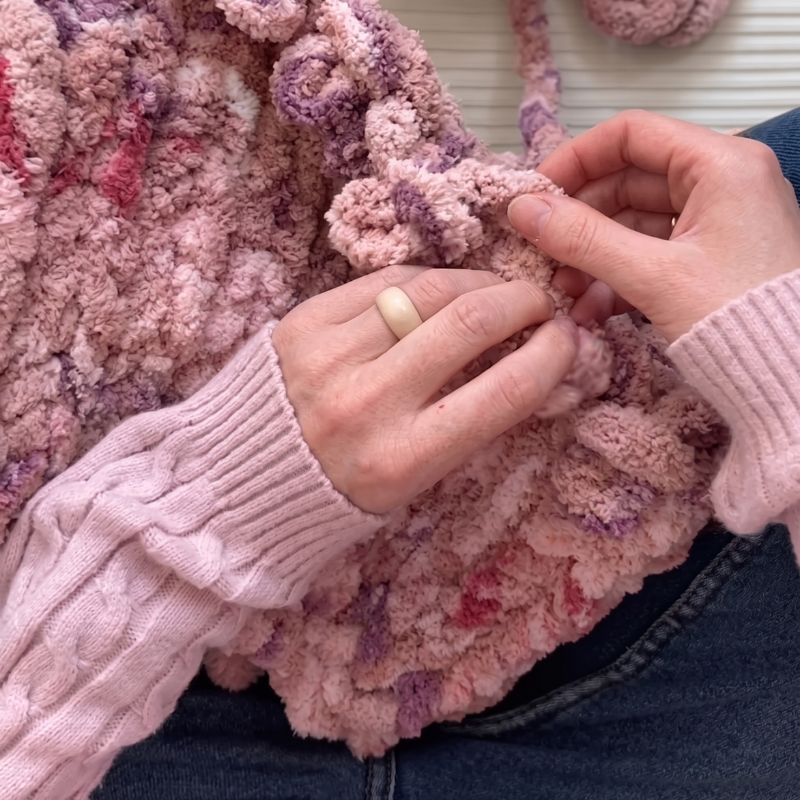
The easiest DIY hobby – armknitting.
Watch the video

Just 15 minutes and one skein of yarn – that’s all you need to make a pillow
Watch the video
FAQ – Everything You Need to Know About Chenille Yarn
Chenille yarn (from the French word for caterpillar) is a distinctive type of yarn whose structure resembles a fluffy caterpillar. It consists of a core into which dense, short fibres (usually polyester) are woven, creating a velvety "fur-like" effect. Thanks to its thickness (approx. 2 cm) and exceptional softness, chenille yarn is used mainly for hand knitting blankets, throws, decorative cushions, and pet beds. It is valued for its lightness, thermal insulation properties, and hypoallergenic nature.
Yes, finger-knitting chenille yarn is the best choice for those just starting out with handcraft. Thanks to the large stitch volume, results are visible almost immediately. Knitting a blanket requires no knowledge of complex patterns or tools – all you need are your hands and a simple loop-over-loop technique. A single 230g skein lets you create a piece approximately 60x40 cm in less than an hour.
The amount of material needed depends on the size of the project and the density of your stitch. Based on a standard skein weight of 230g, average consumption is as follows:
- Small baby blanket (approx. 75x100 cm): 3–4 skeins.
- Standard blanket (approx. 90x150 cm): 6 skeins.
- Large throw (approx. 120x180 cm): 9–10 skeins.
- King Size bedspread (approx. 180x200 cm): 15–16 skeins. If you choose Chenille Ombre yarn in a large 600g skein, just 2 skeins are enough for a standard blanket.
The main difference is linear fibre density. Premium chenille yarn has significantly more microfibres woven into the core, making it more "substantial", compact, and silky to the touch. The Standard version is lighter and more budget-friendly, while Premium delivers the look of an exclusive, heavier stitch with no visible gaps. Both types carry the Oeko-Tex certificate, guaranteeing skin safety.
Items made from chenille yarn are durable but require proper care. They can be machine washed, provided you select a delicate fabric programme (max 30°C) and use a laundry bag to prevent the fibres from snagging. It is very important to limit the spin cycle (max 400 rpm) and to dry flat. Never hang a wet blanket, as its weight can permanently distort the stitch.
Although this yarn is designed for finger knitting, tools can be used very successfully. The recommended size is 25 mm knitting needles or a crochet hook. Working with tools produces a more regular, uniform stitch, while hand knitting gives the piece a unique, rustic character.
Good quality polyester chenille yarn is characterised by minimal shedding. The Premium and Select versions are additionally stabilised to reduce pilling during everyday use. It is worth remembering, however, that like any microfibre product, chenille does not respond well to friction against very rough surfaces.
The Oeko-Tex Standard 100 certificate is a guarantee that the chenille yarn has been tested for over 100 harmful substances. This is crucial if you are creating accessories for infants, children, or people with atopic dermatitis. Our yarns are free from pesticides, heavy metals, and allergenic dyes.
A single 230g skein is the perfect amount for small zero-waste projects. You can use it to make:
- A round decorative cushion (a so-called knot cushion).
- A soft bed for a small cat.
- A warm neck warmer.
- A small basket for odds and ends.
Yes, as with other dyed materials, the shade of a given chenille yarn may vary subtly between production batches. For this reason, for larger projects we always recommend purchasing the required number of skeins in a single order, to ensure the entire blanket has a perfectly uniform colour.